Bell’s inequalities distinguish ‘local’ theories and ‘non-local’ theories. Here, we loosely define a ‘local’ theory as a theory where the likelihood of events occurring (i.e., the possibility to observe specific measurement results) purely depends on the direct environment. If you consider an ‘Alice’ and a ‘Bob’ at different sides of the world, then in a local theory, the actions of Alice cannot instantaneously influence what Bob observes.
Nowadays, no scientist disputes that Nature violates Bell’s inequalities. There is enough (Nobel prize-winning) experimental evidence for this. The academic debate around Bell’s inequalities centers around whether we can conclude from the violation of Bell’s inequalities that Nature is ‘non-local.’ For some, this is a clear conclusion. For instance, Nicolas Gisin wrote in 2023 [1]:
Quantum non-locality is here to stay; the experimental evidence is clear on that point.
For others, like Sabine Hossenfelder, the situation is less clear when she refers to the experimental evidence [2]:
Contrary to what is often stated, these observations do not demonstrate that “spooky action at a distance” is real and Nature therefore non-local.
The debate on (non-)locality can get heated. Some participants identify ‘factions’ of localists, whom they accuse of lack of rigor [3]:
The terms ‘non-locality’ or ‘quantum non-locality’ are buzzwords in foundations of quantum mechanics and quantum information. Most scientists treat these terms as a handy expression equivalent to the clumsy “violation of Bell’s inequalities”. Unfortunately, some treat them seriously.
Some scientists (like Justo Pastor Lambare in his recent contribution [4]) go further and state that the analysis of the ‘localists’ is wrong:
The alleged non-local character of quantum mechanics is inextricably related to the formulation of the Bell theorem. That relation, however, is commonly incorrectly assessed.
Information Causality
In this post, we analyze the work that Marcel Pawłowski published in his 2021 paper [5], “Information Causality without Concatenation.” This paper focuses on the distinction between what we could loosely call ‘useless non-locality’ and ‘useful non-locality.’ Useless non-locality can lead to correlations between events for Alice and Bob but does not enhance communication. On the other hand, useful non-locality can be used to improve communication between the two parties. If we consider a communication channel between Alice and Bob with a certain capacity, then with ‘useless non-locality,’ the amount of information shared is limited by the capacity of that channel. On the other hand, useful non-locality could enhance communication and allow Alice and Bob to exceed the channel’s capacity.
Pawłowski phrases this as ‘Information Causality’ [6]. Information causality is about forbidding more information to be potentially available to the receiver than has been sent by the sender [7]:
If for instance Alice has a certain amount of information, then the amount of information potentially available to Bob about Alice’s input cannot exceed M bits. Notice that it does not matter how this information is encoded: when we refer to ‘sending the M bit message’, it should be understood as a single use of a channel with classical communication capacity M.
If we can demonstrate that we can violate Information Causality with quantum non-locality, then the statement that non-locality is merely a buzzword would not hold. If, on the other hand, we find that the non-locality observed in quantum mechanics cannot violate Information Causality, we have created a significantly sharper definition of the boundary posed by Nature.
Guessing game
Imagine that Alice and Bob play a ‘guessing game’ (we discussed this game in an earlier post). In this game, Alice has a string of n bits and communicates m bits to Bob. After receiving Alice’s bit, Bob’s task is to guess the value of a single bit in Alice’s bitstring for a given index. So, Alice receives a bitstring as an assignment, and Bob gets an index. Bob does not know the value of Alice’s bits, and Alice does not know which index Bob should guess. They can communicate m bits, and then Bob has to make his guess. Bob’s success rate is directly related to the amount of knowledge he has on Alice’s bitstring. If he knows the full bitstring, his success rate will be 100%; if he does not know anything about Alice’s bits, his success rate will be 50%.
Pawłowski considers this guessing game for the situation that Alice has a bit string of length 2 (n =2) and communicates one bit to Bob (m = 1). The communication channel that Alice and Bob share is a ‘noisy’ channel, i.e., when Alice sends a bit through this channel, there is a probability that the bit is flipped before it arrives at Bob’s side.
For this game, Information Causality dictates that the amount of information available to Bob does not exceed the capacity of the communication channel. We have modeled this game in Python (see the Jupyter Notebook on GitHub for more details).
First, we can establish the information capacity of the channel from the probability that a bit is flipped:

Here we use the concept ‘binary entropy’ from information theory which depends on the probability that a bit is correct:

As the next step, we establish the amount of information Bob needs to achieve a certain success rate. If Alice’s bitstring length is 2, then the mutual information is

Deriving this formula for mutual information is beyond the scope of this blog. Still, to get some intuitive feel, consider the case where Bob’s success rate is 100%. The binary entropy for this probability is 0, so I is 2. Two bits of mutual information make sense as Bob can correctly guess the value of the two bits on Alice’s side. On the other hand, if Bob’s success rate is 50%, the binary entropy is 1. The mutual information is, in this case, zero. Also, this outcome makes sense since, for guessing a bit, a success rate of 50% means Bob has no prior information.
Information Causality now states that the mutual information cannot exceed the capacity of the channel, so

In Figure 1, we plot Bob’s maximum allowed success rate for a classical channel with a given error rate. We see that if the error rate is near zero, Bob’s success rate is between 85% and 90%. When the error rate increases, Bob’s success rate will decrease, and for a channel with a 50% error rate, his success rate should not be above 50% (effectively, for a channel with this noise level, Bob receives a random bit from Alice and the two are not able to communicate).
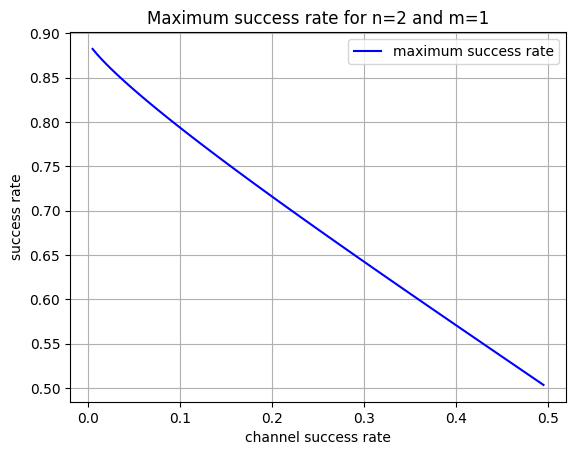
Figure 1. Maximum allowed success rate for Bob after receiving one bit from Alice.Note that the success rate shown in Figure 1 is the maximum information theory allows.
Of course, Bob and Alice can agree on an algorithm with a lower success rate. The only conclusion we can draw is that we do not expect to see higher success rates unless additional communication is established.
Non-local resources
As the next step, we allow Alice and Bob to utilize non-local resources. Specifically, we will enable them to use entangled photons or ‘superphotons.’ Sandu Popescu and Daniel Rohrlich proposed these ‘superphotons’ in 1994 [8] (see also our earlier post). These Popescu-Rohrlich photons show a correlation beyond the Tsirelson bound. We can also say that they show non-locality beyond quantum mechanics. In our code (see GitHub), we implemented the Popescu-Rohrlich photons such that we can set their ‘quantumness’ by a parameter q. For a q-value of 1, they behave as regular entangled photons, and for increasing values for q, their behavior becomes more and more non-local. Ultimately, for very high q-values, the photons would exhibit the largest conceivable violation of Bell’s inequalities.
We implemented Pawloswki’s algorithm for the guessing game in Python, using the package FockStateCircuit to model the quantum behavior of photons. This package has a built-in feature that works with Popescu-Rohrlich photons.
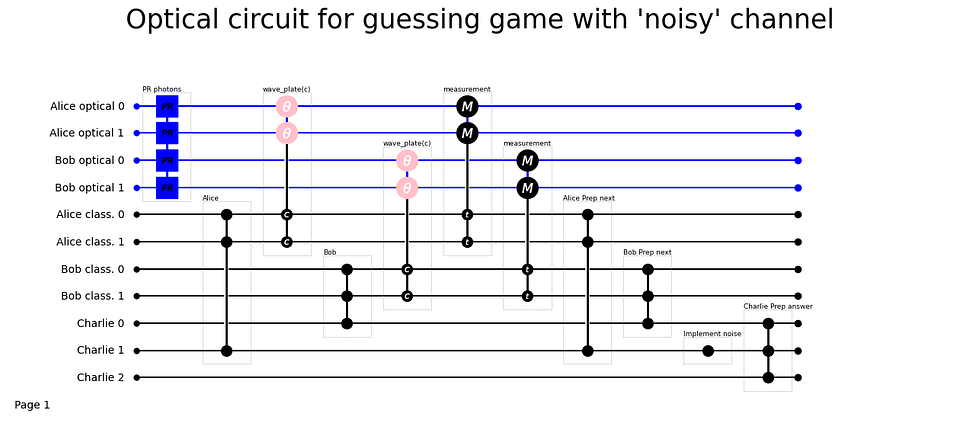
Figure 2. Circuit for the guessing game as created in the Python package ‘FockStateCircuit.’
In Figure 2, you can see the circuit schematics. We have two optical channels for Bob and two for Alice (per photon, we need one channel to model horizontal and one to model vertical polarization, so we need two channels per photon). Then, we also have the classical channels for Alice and Bob, where they receive input from ‘Charlie’ and can store their measurement results. Charlie is the independent judge handing out the assignment. Charlie channel 0 contains the index of the bit Bob has to guess. Charlie’s channel 1 contains the number representing Alice’s bitstring, and we use Charlie’s third channel to store Bob’s final guess.
We can run this circuit for various q-values and noise levels in the communication channel. Figure 3 depicts the result. The green dots represent Bob’s success rate for a q-value of 1 (so for regular entangled photons). We see that for this q-value, the success rate is always below the maximum allowed by Information Causality. So, although the entangled photons violate Bell’s inequalities (and would be considered non-local), Alice and Bob cannot utilize this non-locality to enhance their communication.
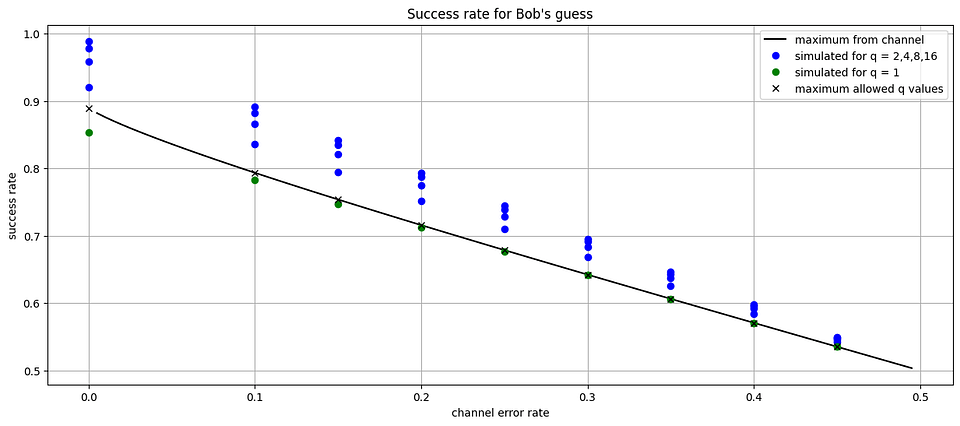
Figure 3. Bob’s success rate for a q-value of 1 (regular entangled photons) does not exceed what information theory permits. For q-values above one, Information Causality is violated. This is why non-locality in quantum mechanics is limited.
The blue dots in Figure 3 show what happens if we give Alice and Bob a pair of Popescu-Rohrlich photons with a q-value above 1. For q-values larger than 1, Bob’s success rate can exceed what Information Causality permits. If quantum mechanics had allowed slightly stronger non-locality, or if quantum mechanics had broken Bell’s inequalities just a bit more, this would have immediately broken information causality. The Tsirelson bound for quantum mechanics has precisely the correct value to avoid that we can use non-locality to enhance communication. Quantum mechanics is non-local but does not permit faster-than-light communication.
The points marked with an ‘x’ in Figure 3 indicate the highest allowed q-value for which we do not break Information Causality. In Figure 4 we plot these q-values against the error rate in the communication channel. We see that when then error rate in the channel is low (i.e., the noise level is low) in principle q-values beyond quantum mechanics would be allowed. However, when the channel becomes more noisy the maximum q-values becomes equal to the Tsirelson bound. So we see that Nature places the upper limit for quantum non-locality exactly where this non-locality would switch from ‘useless’ to ‘useful’
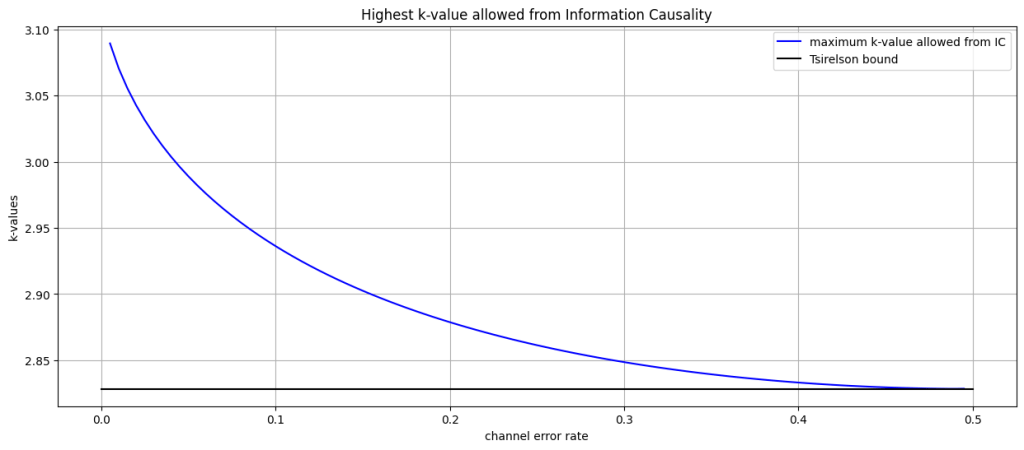
Figure 4. When the noise level in the communication channel approaches 0.5, the highest allowed q-value is the Tsirelson bound.
Conclusion
Nature might be non-local, but Nature does ensure that that non-locality is not used for communication. In fact, it appears that the non-locality is limited to exactly the level where we could use it to enhance communication. Possibly this means that Information Causality is one of the governing principles of physics, and that we can derive the characteristics of quantum mechanics from this principle. This conclusion still leaves open the question on non-local correlations which are observed in experiments where Bell’s inequalities are violated. Whether these correlation truly indicate non-locality, or whether we can identify alternative mechanisms remains an open debate.
Please leave your build and comments on this post. See also GitHub Pages and the full code in the GitHub repo.
References
[1] N.Gison, “Quantum non-locality: from denigration to the Nobel prize, via quantum cryptography,” Europhysics News, vol. 54, 1, pp 20–23, 2023. https://doi.org/10.48550/arXiv.2309.06962
[2] Hance, J.R. and Hossenfelder, S. “Bell’s theorem allows local theories of quantum mechanics,” Nat. Phys. 18, 1382 (2022). https://doi.org/10.1038/s41567-022-01831-5
[3] M. Żukowski and Č. Brukner, “Quantum non-locality - it ainʼt necessarily so…,” J. Phys. A: Math. Theor. 47, 424009 (2014). http://dx.doi.org/10.1088/1751-8113/47/42/424009
[4] J. Lambare, “A Critical Analysis of the Quantum Nonlocality Problem: On the Polemic Assessment of What Bell Did,” https://doi.org/10.20944/preprints202205.0015.v4
[5] N. Miklin and M. Pawłowski, “Information Causality without Concatenation,” Phys. Rev. Lett. 126, 220403 (2021). https://doi.org/10.48550/arXiv.2101.12710
[6] M. Pawłowski, T. Paterek, D. Kaszlikowski, V. Scarani, A. Winter and M. Zukowski, “Information causality as a physical principle,” Nature 461, 1101 (2009). https://doi.org/10.1038/nature08400
[7] M. Pawlowski and V. Scarani, “Information causality,” https://doi.org/10.48550/arXiv.1112.
[8] S. Popescu, D. Rohrlich, “Quantum nonlocality as an axiom,” Found Phys 24, 379 (1994). https://doi.org/10.1007/BF02058098
[9] Full code and more background can be found on the repository on GitHub https://github.com/robhendrik/Non-Locality-Versus-No-Signalling and on GitHub Pages https://robhendrik.github.io/Non-Locality-Versus-No-Signalling/


Leave a Reply