Imagine photons that push beyond the limits of quantum mechanics — achieving perfect coordination without breaking relativity. In this post, we explore these ‘super-photons’: what would be their feats and failures [1]?
Quantum physics is famously strange. Entangled particles can share connections that defy classical intuition — what Einstein called “spooky action at a distance.”
But even this strangeness has limits. Bell’s theorem tells us that no local hidden-variable model can reproduce quantum correlations. Yet quantum mechanics doesn’t break Bell’s bound as much as it could. There exists a mathematical ceiling higher than the quantum one, still consistent with relativity — still respecting the rule that no signal can travel faster than light.
This realization led Sandu Popescu and Daniel Rohrlich in 1994 to ask a bold question [2]:
> What if there existed hypothetical devices that produce even stronger correlations than quantum physics allows — yet still forbid signalling?
They called these devices Popescu–Rohrlich (PR) boxes.
Valerio Scarani’s 2006 review — “Feats, Features and Failures of the PR-box” — explores this idea in depth, asking what such “superquantum” systems could teach us about the true structure of nature [1].

Figure 1: Valerio Scarani Source: https://www.iqoqi-vienna.at/blogs/blog/valerio-scarani
The Puzzle of Perfect Nonlocality
Quantum mechanics is nonlocal — entangled particles can exhibit correlations that no classical system could mimic. Yet, quantum correlations have limits. The CHSH inequality tells us how much nonlocality a theory allows:
- Classical (local) world: CHSH ≤ 2
- Quantum world: CHSH ≤ 2√2 ≈ 2.828
- Superquantum (PR) world: CHSH = 4
The PR box imagines a world where two parties, Alice and Bob, can achieve perfect correlations without allowing any faster-than-light signalling. These boxes are such that you can choose one measurement out of two options (so we can call the measurement for Alice x, with value 1 or 0, and we call the measurement for Bob y, with value 1 or 0). The outcome from this measurement is also binary, so we get result a for Alice (1 or 0) and result b for Bob (also 1 or 0). There is a simple rule that leads to the highest non-locality:
> If Alice or Bob chooses measurement ‘0’ then the outcomes a and b will always the be same (both 1, or both 0). But, if Alice and Bob both select 1 (so (x,y) = (1,1)) they always get opposite outcomes (either (a,b) = (1,0) or (a,b) = (0,1)).
Mathematically we can write this as
a + b (mod 2) = x * y
Each output (a or b) is individually random, yet together they always satisfy this relation. The PR box is consistent with relativity (no signalling) but more nonlocal than quantum mechanics — a tantalizingly strange possibility.
Features — When Everything Becomes Too Easy
The PR-box doesn’t just reproduce non-local quantum correlations; it overshoots them.
That turns out to be both fascinating and deeply problematic.
In 2005, Wim van Dam discovered that if PR-boxes existed, communication complexity would collapse [3].
Normally, when two distant parties want to compute a joint function of their inputs — say, Bob wants to know whether his data matches Alice’s — they need to exchange information. Even with quantum entanglement, this communication cost never disappears.
But with PR-boxes, it does. Using them cleverly, Alice and Bob can compute any distributed Boolean function while exchanging only a single bit of communication, regardless of how large their data sets are.
Information theory, as we know it, would become trivial.
Van Dam suggested that this implausible simplicity might explain why nature doesn’t realize PR-box correlations. Quantum mechanics seems finely tuned: nonlocal enough to violate Bell inequalities, but not so nonlocal that all communication becomes unnecessary.
This idea later inspired the principle of Information Causality, which formalizes that same intuition [4]:
> The information Bob can gain about Alice’s data cannot exceed the amount of classical communication between them.
So far, PR-boxes look like perfect nonlocal machines. Now, let’s take the next step: we try to build a dynamical world around PR boxes — one that allows operations like entanglement swapping or joint measurements.
Entanglement Swapping — Linking Distant Pairs
In quantum physics, entanglement is not static. It can be swapped or teleported — two separate pairs of particles can be “coupled” through a joint measurement, creating new entanglement between partners who never interacted [5].
Let’s see what that means.
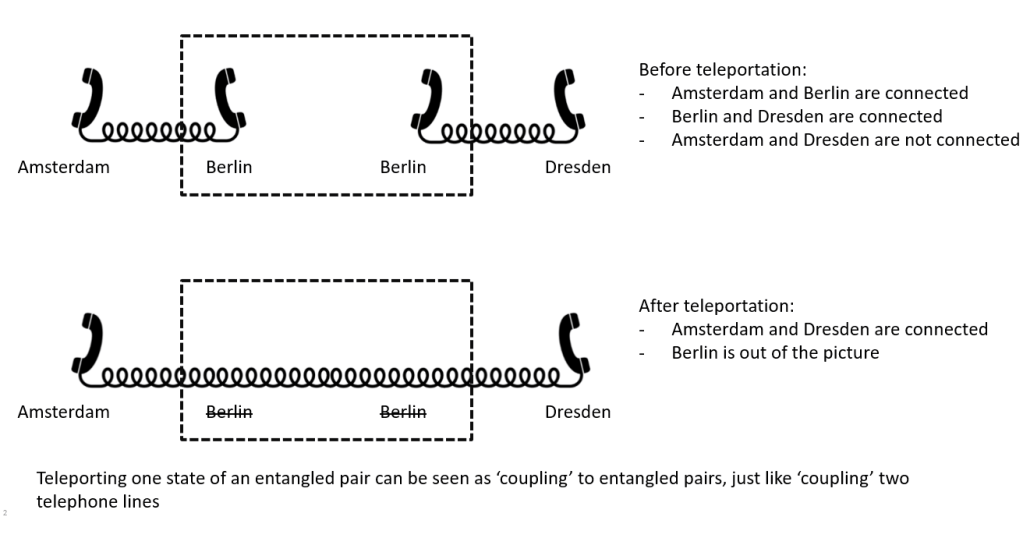
Figure 2: Teleportation of one state of an entangled pair can be seen as coupling two entangled pairs where two end-points become connected and the intermediate points disappear from the line.
Before teleportation:
- Amsterdam and Berlin are connected.
- Berlin and Dresden are connected.
- Amsterdam and Dresden are not connected.
After teleportation:
- Amsterdam and Dresden are directly connected.
- Berlin is out of the picture.
Teleportation is like coupling two telephone lines: a temporary operation in the middle city (Berlin) creates a new direct link between the two outer cities.
In quantum mechanics, the same idea plays out with particles and we use teleportation to achieve this.
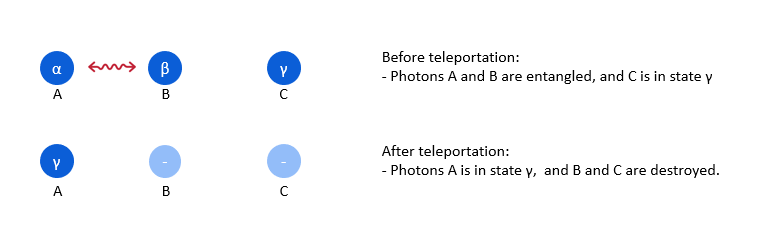
Figure 3: Illustration of teleportation the state of a source photon (photon C in this case) to a target photon (photon A in this case).
Before teleportation:
- Photons A and B are entangled.
- Photon C is in an independent state γ.
After teleportation:
- Photon A now has state γ.
- Photons B and C are destroyed in the process.
The original state “jumps” from one particle to another — not through space, but through entanglement.
Now look what happens if we add one more particle, such that initially we have two pairs of entangled particles (just as in our phone line analogy we had two phone lines each connecting a pair of cities.)
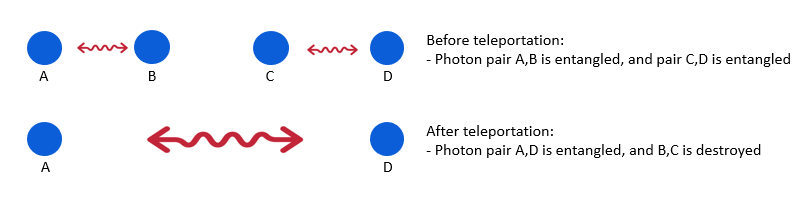
Figure 4: Illustration of teleporting one photon of an entangled pair, resulting in the target photon becoming entangled just as the source photon originally.
Before teleportation:
- Pair (A, B) is entangled.
- Pair (C, D) is entangled.
After teleportation (a joint measurement on B and C):
- Pair (A, D) becomes entangled.
- B and C are destroyed.
Just as in our phone line example we have created connection between two initially not connected particles, by performing an operation ‘in the middle’.
This process — entanglement swapping — is the backbone of quantum repeaters and teleportation networks.
It shows that quantum entanglement supports coherent transformations, operations that create and rearrange correlations dynamically.
The Paradox of the PR Box
The natural question is: can we define a similar operation for PR boxes?
We demand that this hypothetical operation, a coupler, should:
- Be universal — defined for any two boxes, not just specific ones.
- Be linear — mixtures of boxes lead to mixtures of outcomes.
- Respect no-signalling — no faster-than-light communication.
Let’s see if such a coupler can exist.
Scenario 1: Bob applies the coupler first
- Bob takes his two PR boxes and applies the coupler.
- The result is a new effective box between Alice and Charlie.
- Because the PR boxes are maximally nonlocal, the outcome correlations can be arranged to be another PR box: CHSH = 4.
Everything looks fine.
Scenario 2: Alice and Charlie measure first
Now switch perspectives. In a relativistic world, time order can differ for distant observers.
- Suppose Alice and Charlie make their measurements first.
- Then, using the PR box rule, Bob’s outcomes are already fixed functions of Alice’s and Charlie’s choices and results.
- When Bob applies the same coupler afterward, he’s acting only on local deterministic data.
Because local deterministic data cannot generate new nonlocal correlations (that would violate no-signalling), the resulting Alice–Charlie box must be local, with CHSH ≤ 2.
Now we have a contradiction: in one frame, CHSH = 4; in another, CHSH ≤ 2. A single physical experiment cannot have two incompatible outcomes just because of a change in time order.
The Verdict
There is no universal, linear, no-signalling coupler for PR boxes. Any attempt to create one violates relativistic consistency [6].
This is the essence of the PR Box Paradox: perfect nonlocality and consistent dynamics cannot coexist.
Why the Contradiction Appears: No Internal Dynamics
The PR box is purely operational. It has inputs, outputs, and probabilities — but no internal structure. There are no vectors, no amplitudes, no transformations, no notion of what it means to “measure jointly” or to “evolve” the system.
In quantum theory, these features are built in:
- States are vectors (or density matrices) in Hilbert space.
- Measurements are linear operators.
- Dynamics are unitary transformations.
- Joint systems live in tensor products.
This internal algebra ensures that operations on space-like separated systems commute — the order of measurements doesn’t matter. The PR box, by contrast, has no such machinery. It’s a table of probabilities and nothing more.
So the contradiction arises not from relativity itself, but from the absence of an internal dynamic structure that ensures consistency.
Adding Internal Dynamics – and Losing Perfect Nonlocality
What if we try to repair this? Suppose we give PR boxes some internal structure — perhaps a continuous set of “measurement directions” that we can rotate between, like the Bloch sphere for quantum spins.
Now we face a new problem: if the correlations depend smoothly on rotation angles, they cannot stay pinned to ±1 as in a PR box. Instead, the correlations must vary continuously, typically following a cosine law:
E(a,b) = -cos(theta)
where theta is the angle between measurement directions.
This smooth dependence guarantees consistency across different measurement orders, but it also softens the correlations. The CHSH value now reaches at most 2√2 — exactly the quantum Tsirelson bound [7]
In other words:
> Adding internal dynamics (rotations, continuous states) forces the correlation strength to drop from 4 to 2√2.
We’ve traded perfect nonlocality for mathematical coherence.
The Trade-off: Nonlocality or Dynamics
This brings us to the central insight of the PR Box Paradox:
> You can have perfect nonlocality (CHSH = 4), or you can have consistent internal dynamics (rotations, joint operations, time-order invariance). You cannot have both.
A theory with PR boxes is too rigid — it has static, discontinuous edges. It can define correlations but not processes. Once we try to make it evolve or compose systems, contradictions appear.
Quantum mechanics sits precisely at the sweet spot: it gives up maximal nonlocality but gains a coherent dynamical structure that allows measurement, rotation, teleportation, and entanglement swapping — all without inconsistency [8]
Why Nature Chooses the Middle Ground
The world we live in seems to have chosen a compromise:
- Not as local as classical physics (CHSH = 2),
- Not as nonlocal as a PR universe (CHSH = 4),
- But exactly as nonlocal as necessary to allow rich, consistent dynamics (CHSH = 2√2).
Quantum mechanics thus balances two opposing forces:
| Property | Extreme PR world | Quantum world |
|---|---|---|
| Nonlocality | Maximal (4) | Limited (2√2) |
| Dynamics | Impossible | Smooth and reversible |
| Consistency | Broken under coupling | Guaranteed by Hilbert structure |
The PR Box Paradox shows that nonlocality and dynamics are not independent resources — they constrain each other. Nature seems to prefer less nonlocality in exchange for a world that can evolve, interact, and make sense.
References
[1] V. Scarani, “Feats, Features and Failures of the PR‐box,”. AIP Conf. Proc. 844. 309 (2006). https://doi.org/10.1063/1.2219371
[2] S. Popescu, S. and D. Rohrlich, “Quantum nonlocality as an axiom,” (1994). Found. Phys. 24, 379–385.
[3] W. van Dam, “Implausible consequences of superstrong nonlocality,” Nat Comput 12, 9–12 (2013). https://doi.org/10.1007/s11047-012-9353-6
[4] M. Pawłowski, T. Paterek, D. Kaszlikowski, V. Scarani , A. Winter and M. Zukowski, “Information causality as a physical principle,” Nature 461, 1101 (2009). https://doi.org/10.1038/nature08400
[5] D. Bouwmeester, J.-W. Pan, K. Mattle, M. Eibl, H. Weinfurter and A. Zeilinger, “Experimental quantum teleportation,“ Nature 390, 575 (1997). https://doi.org/10.1038/37539
[6] Short, A. J., Popescu, S., & Gisin, N., “Quantum nonlocality and the structure of the set of no-signalling correlations," (2006).arXiv:quant-ph/0608122.
[7] Janotta, P., Gogolin, C., Barrett, J., & Brunner, N. “Limits on non-local correlations from the structure of the local state space," (2010). arXiv:1012.1215.
[8] Chiribella, G., D’Ariano, G. M., & Perinotti, P. “Quantum Theory from First Principles," (2017). Cambridge University Press.


Leave a Reply